Introduction:
The words are
iqtiham and
inghimas.
Why are these two recondite words from a medieval desert language important to us?
Because
an influential Muslim scholar who lives in London (yes, in this 21st
century, not the 18th, or the 13th, or the 7th) wrote:
"On the one hand, we use the proofs and the
texts calling for bravery and penetrating [iqtiham] and storming [inghimas]
enemy lines - but this without being foolhardy - and [this is permitted] even
if it leads to one's being killed by the enemy, so long as there is in one's
storming [enemy lines] an overriding benefit to the jihad, to Islam, and to the
Muslims. On the other hand, we have the proofs and the texts that forbid one to
kill one's self. The reconciliation [of these two groups of texts] is possible
and easy, and there is absolutely no need to have recourse to limiting [the
application of] or abrogating [texts]!"
Doesn't this Islamic scholar have better things to think about?
Of course he doesn't. My apologies for that silly question. Onward.
The
words are, unfortunately, important because this modern Islamic scholar
living in the West is parsing the proprieties and niceties of
how and why to kill us.
Background:
A manual of Islamic law,
Reliance of the Traveler,
approved today in the 21st century (not in the Middle Ages) by the most
prestigious Islamic university in the Muslim world, Al Azhar Madrassa
in Cairo, states:
"There is no disagreement among scholars that it is
permissible for a single Muslim to attack battle lines of unbelievers headlong
and fight them even if he knows he will be killed."
(q2.4(4))
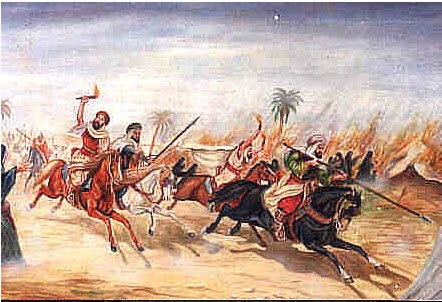
Literally, the word
inghimas, as we see in its Persian cognate, means:
Being plunged into water.
And the word
iqtiham, means:
Rushing headlong...
(From:
A Comprehensive Persian-English Dictionary, ed., Francis Joseph Steinglass)
Both words, as used by our scholar of the Religion of Peace, seem to
be rough equivalents, in terms of a particularly fierce and ferocious battle tactic.
The former,
inghimas, then
acquired the meaning of "plunging into", as an intransitive verb,
denoting a person plunging into a crowd -- which, for non-Muslims, would
mean in some happy, celebratory capacity (say, going moshing at a rock
concert); but for Muslims, ever obsessed about the Enemy around them and
how to kill them, is meant in the more deadly-serious way, as a
plunging into a crowd of the Enemy in order to kill them with your sword
(before the Infidels helpfully invented explosives, automobiles and planes for Muslims to
pirate).
Discussion:
To get back to our mainstream Islamic scholar living in London. His full Arabic name is
Sheikh
'Abd Al-Mun'im Mustafa Halima, but he is known for short as Al-Tartusi,
and that's what we'll call him, avoiding the unpleasant mouthful of his
more official Islamic moniker.
As the excellent website
Memri.org
tells us, Al-Tartusi is a Syrian expatriate living in London (though
perhaps more recently he has decided to plunge back into his homeland to
help out with the Arab Spring there), "considered to be a prominent
theoretician of the Salafi jihadist trend in Islam [i.e., mainstream
Islam]. On August 24, 2005 he posted, on his
eponymous website, an article that included a fatwa against suicide
attacks."
Al-Tartusi's fatwa primarily deals with the
analysis of the distinction between suicide (unlawful in Islam) and the
aforementioned impetuous military tactic: it is not suicide (
intihariya), says the modern Muslim scholar, but rather martyrdom (
istishhadiya)
-- a-ok in Islam; indeed, a veritably honorable achievement,
guaranteeing Paradise to the Mohammedan ever anxious about whether he
will be sent to Hell to be tortured, or to Paradise to have sex and eat
fruits and drink wine forevermore.
At first blush, when reading this fatwa, one gets the impression that
Al-Tartusi is trying to delegitimize suicide bombing as... suicide.
However, on a closer reading, we see that when he is making this distinction,
he is not on Islamic grounds objecting to the headlong plunge into enemy
lines that will result in the Mohammedan being killed as he
valiantly kills the enemy: he only objects to the Mohammedan doing this
in order to be killed -- i.e., when, that is, suicide unrelated to the jihad would be an ulterior motive for plunging into
battle.
The primary guiding motivation, for the representative of the
Religion of Peace, should be
killing, with one's consequent death
being fully accepted but not primarily sought out. So, you see,
Muslims are capable of complex logical arguments. The problem is not
that they are all stupid barbarians; the problem is that their religious
and cultural authorities use their intellectual training and tradition
to analyze questions and issues pertaining to concerns that are, to the
non-Muslim, monstrously unethical and fanatically dangerous.
Thus, for example, Al-Tartusi writes of:
...proofs and the texts calling for bravery and penetrating
[iqtiham] and storming [inghimas] enemy lines - but this without being
foolhardy - and [this is permitted] even if it leads to one's being
killed by the enemy, so long as there is in one's storming [enemy lines]
an overriding benefit to the jihad, to Islam, and to the Muslims.
Al-Tartusi
in his fatwa "against suicide bombing" goes on to more closely examine
the distinction between "storming [the enemy's ranks]..., and killing
one's self, as in suicide attacks...":
One who storms [enemy ranks] is killed by the enemy, whereas
one who carries out a suicide attack kills himself, and so in this they
are not equal.
At this particular juncture, Al-Tartusi is being a bit sophistically literal. At the very
least, he would have to present an argument that proves that the death
resulting in attack has to be directly inflicted by an enemy.
That the one who storms enemy ranks will be killed is probable,
but not certain, since many of those who storm the ranks of the enemy
disperse their army and succeed in their mission without being killed.
There is no better witness to this than the history of jihad in Islam.
In contrast, someone who blows himself up in a suicide attack has killed
himself for sure, and so in this they are not equal.
I guess Al-Tartusi then would congratulate the Mumbai jihadists, for
the fine Islamic example they demonstrated in killing the enemy the
old-fashioned way.
...one cannot say that [this is because] our forefathers did not
have explosives at their disposal so as to be able to draw the analogy,
since there was no shortage of ways of killing one's self, and they are
plentiful in every time and place.
Al-Tartusi is
ignoring the precise difference between modern
explosives (and airplanes), and what was available to pre-modern
Muslims. Pre-modern devices and weapons were not conducive to
simultaneously inflicting casualties on an enemy and killing oneself (we
are not considering here malfunctioning catapults that may have fired
backwards) --
whereas modern explosives are perfectly suited to the carrier of
explosives doing so. And this gains advantage when a human carrier of
explosives is more capable of effectively penetrating enemy lines --
i.e., crowded areas where Unbelievers (= Enemies) are gathered
(particularly Unbelievers who are glibly gullible in preening themselves
about how multiculturally "tolerant" they are of the Other).
Al-Tartusi's
main complaint with suicide-bombers is that they are not
scrupulously following the stipulations in the Sunna (he also
disingenuously tries to piggyback onto that a claim that
suicide-bombings are not strategically effective, as well as the anxiety
that they are bad for the image of Islam, and that they tend to foment
discord among Muslims). And yet, he notes a fact that is "very
discomfiting" -- namely, that over 90% of suicide attacks by Muslims are
deficient in adherence, so he claims, to all the proper jots and
tittles of
the Sunna. Even if Al-Tartusi is correct about the Islamic
unacceptability of suicide attacks, his own admission that over 90% of
such attacks are not following his version of Islamic compliance shows
that there is obviously a monstrous problem in Islamic education
conducive to such a rampant culture of violence that is, of course,
threatening us Infidels. If exploding Muslims aren't listening to
Al-Tartusi, then what good is he? At any rate, he believes in killing
the Enemy -- properly -- and that should be all we need to know.
Back in 2005, Walid Phares wrote in an essay published in The Washington Times (also reported by Jihad Watch) that:
Sheik al-Qardawi went as far as linking today's suicide bombing to what
he called "inghimass" (to throw oneself against the enemy). According to
him, this has been permitted by religious teaching since the early days
of Islam. A fatwa issued in the West or in the United States must
respond to Sheik al-Qardawi and the jihadists theologically, and not
state globally what international law and 52 Muslim countries subscribe
to already.
And if the reader doesn't know how popular and mainstream Qaradawi is,
this report from the mainstream media shows that Qaradawi was at the epicenter of the
recent Egyptian Revolution, and in an unprecedented rally of over
200,000 in February of last year, he delivered the solemn Friday prayers
to all those Egyptian “secularists” gathered there. The writer of that
news article also notes that Qaradawi is “spiritual leader to the
Muslim Brotherhood” in Egypt, and is “very much in the Sunni
mainstream”.
And Memri.org has also
documented how Qaradawi presided over a discussion at a major conference among Islamic
clerics held in 2003 in Stockholm) in
which he supported the following statement articulating the relationship
between Muslims and non-Muslims in the context of the justification for
terror attacks:
It has been determined by Islamic law that the blood and property
of people of Dar Al-Harb [the "Realm of War" -- i.e., all non-Muslim lands]
is not protected. Because they fight against
and are hostile towards the Muslims, they annulled the protection of
[their] blood and [their] property…
Postscript: "Running Amok"
I recall, a few years before 9/11 while working in a doctor's office, I was looking through a Dorland's Illustrated Medical Dictionary (26th edition, 1985), my eyes happened to
alight on the word "amok" (a word I never would have expected to see in
a medical dictionary). The definition provided an intriguing
multicultural glimpse:
[Malay
"impulse to murder"] a psychic disturbance seen chiefly in Malaysia,
the Philippines,and parts of Africa, marked chiefly by sudden homicidal
mania, screaming, and attacks on people and inanimate objects, tending
to result in social retribution and leading to the death of the
individual.
While
I commend the 1985 Dorland's medical dictionary for being so
"culturally incorrect", I suspect they, and the Western medical and
anthropological community in general have not even bothered to consider
the Islam factor in explaining this "psychic disturbance" --
particularly as the regions cited are all heavily influenced by Islamic
demographics and historical conquest.
More recently, I checked the charming "Hobson-Jobson" reference, subtitled A Glossary of Colloquial Anglo-Indian Words and Phrases, and
found some interesting entries for "amok" (and its older variant,
"amuck"). We see that the problem of running amok also included India.
Hm; another place where millions of Muslims live. Coincidence?
On pages 18-19, for example, we read:
A MUCK, to run, v. There is we believe no room for doubt
that, to us at least, this expression came from the Malay countries, where both
the phrase and the practice are still familiar. Some valuable remarks on the
phenomenon, as prevalent among the Malays, were contributed by Dr Oxley of Singapore to the Journal of the
Indian Archipelago, vol. iii. p. 532; see a quotation below. [Mr W. W. Skeat
writes --
"The best explanation of the fact is perhaps that it was the
Malay national method of committing suicide, especially as one never hears of
Malays committing suicide in any other way. This form of suicide may arise from
a wish to die fighting and thus avoid a 'straw death, a cow's death'; but it is
curious that women and children are often among the victims, and especially
members of the suicide's own family. The act of running amuck is
probably due
to causes over which the culprit has some amount of control, as the
custom has
now died out in the British Possessions in the Peninsula,
the offenders probably objecting to being caught and tried in cold
blood. I
remember hearing of only about two cases (one by a Sikh soldier) in
about six
years. It has been suggested further that the extreme monotonous heat of
the Peninsula may have conduced to such outbreaks as those of
Running amuck and Latah.]"
The word is by Crawfurd ascribed to the Javanese, and this
is his explanation:
"Amuk (J.). An a-muck; to run a-muck; to tilt; to run
furiously and desperately at any one; to make a furious onset or charge in combat."
-- (Malay Dict.) [The standard Malay, according to Mr Skeat, is rather amok
(mengāmok).]
Sounds like inghimas to me.
Pages
19-21 have more on the Indian origins and incidences, as well as
Javanese -- though of course never do the sources, even old ones before
the dominance of PC MC, consider Islam as a root cause. One even went
so far as to conjecture that the Indian climate was to blame. How can
people be so dense?
Then we have
this evidence
from the Muslim history of the Philippines, concerning the 16th century
(though can we doubt it continued to flare up in the following
centuries...?):
The article adds that:
These slashing attacks kept the Spanish in a constant state of terror...
Yep. That's the Islamic idea.




So for me, it would be irresponsible, when addressing an audience of 2 million people, to say I am against all Muslims - since in reality we must evaluate each person on an individual basis.